Quick answer
Best Millets for Diabetes in India can be part of a balanced Indian diet, but health claims need context. The most useful questions are how much you eat, how the food is prepared, what you eat with it, and whether you have a condition that changes your dietary needs. This guide focuses on practical, evidence-informed choices rather than miracle-food claims.
🔬 Why Millets Work for Diabetes – The Science
Millets have three properties that make them exceptional for blood sugar management. First, they have a very low Glycemic Index (GI) — meaning they release glucose slowly into the bloodstream instead of causing rapid spikes. Second, they are packed with dietary fiber — which slows carbohydrate digestion and reduces glucose absorption. Third, they are rich in magnesium and polyphenols — which improve insulin sensitivity and reduce oxidative stress on pancreatic cells. Research published in the journal Frontiers in Nutrition (2021) found that replacing rice and wheat with millets reduced fasting blood glucose by 12–15% in type-2 diabetics within just 12 weeks.
📊 Glycemic Index of All Major Millets vs Common Indian Foods
| Food | Glycemic Index (GI) | Diabetes Suitability |
|---|---|---|
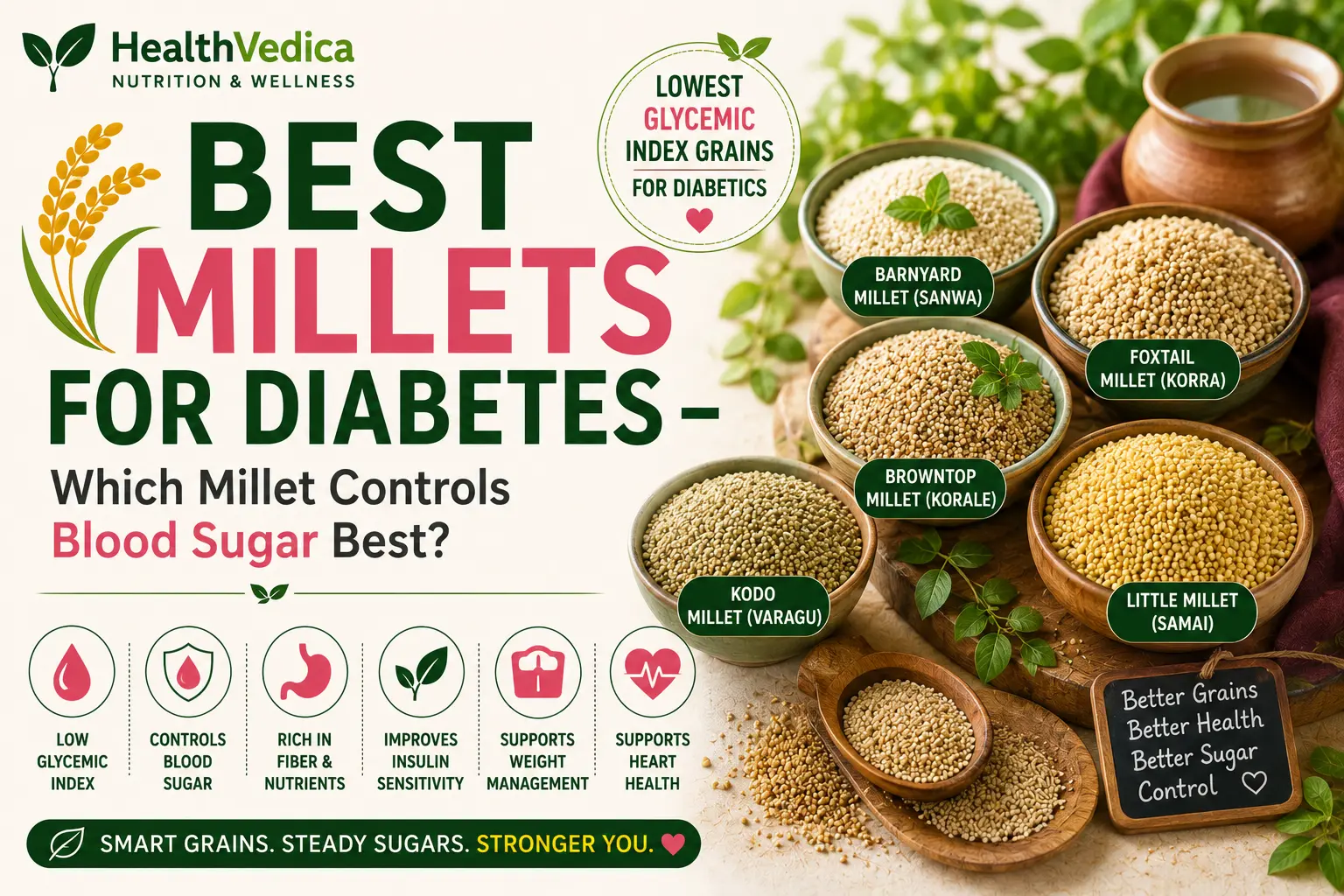
| Browntop Millet (Korale) | 40–48 | ⭐⭐⭐⭐⭐ Excellent |
| Barnyard Millet (Sanwa) | 41–50 | ⭐⭐⭐⭐⭐ Excellent |
| Foxtail Millet (Korra) | 50–54 | ⭐⭐⭐⭐⭐ Excellent |
| Kodo Millet (Varagu) | 49–55 | ⭐⭐⭐⭐ Very Good |
| Little Millet (Samai) | 52–58 | ⭐⭐⭐⭐ Very Good |
| Ragi / Finger Millet | 54–68 | ⭐⭐⭐ Good |
| Pearl Millet / Bajra | 55–68 | ⭐⭐⭐ Good |
| Jowar / Sorghum | 55–70 | ⭐⭐⭐ Good |
| White Rice (Polished) | 73–80 | ❌ Avoid |
| White Bread / Maida | 85–100 | ❌ Avoid |
🏆 Key Millets for Diabetes – Ranked and Explained
1. Browntop Millet (Korale / Andu Korralu) — GI: 40–48
Browntop millet has the lowest glycemic index of all millets, combined with an exceptionally high fiber content of 12.5g per 100g. Research from the University of Agricultural Sciences, Bangalore found it reduced post-meal blood glucose spikes by up to 38% compared to white rice. It is also rich in polyphenols that protect pancreatic beta cells from oxidative damage. Native to Karnataka and Andhra Pradesh, if you can find it — browntop millet is your practical option for diabetes.
2. Barnyard Millet (Sanwa / Kuthiraivali) — GI: 41–50
Barnyard millet is the second-best millet for diabetes and far more widely available than browntop. With 12.6g of fiber per 100g — the highest fiber content among all common millets — it slows glucose absorption dramatically. It is also rich in iron (15.2mg/100g) which is critical because iron deficiency is extremely common in Indian diabetics and directly affects insulin function. Barnyard millet upma and khichdi are ideal breakfast options for diabetics.
3. Foxtail Millet (Korra / Thinai / Kangni) — GI: 50–54
Foxtail millet is the most widely available low-GI millet across all of India and is an excellent daily staple for diabetics. Studies have shown that replacing white rice with foxtail millet for 3 months reduced HbA1c — the 3-month blood sugar average — by 0.5–0.7% in type-2 diabetics. It is also rich in thiamine (Vitamin B1) which supports nerve health, critical since diabetic neuropathy affects up to 50% of long-term diabetics. Foxtail millet rice, foxtail idli, and foxtail upma are easy and delicious daily replacements.
4. Kodo Millet (Varagu / Kodra) — GI: 49–55
Kodo millet is one of the most nutritionally dense millets for diabetes management, containing powerful antioxidants including diosgenin — a compound shown in research to improve insulin sensitivity and reduce insulin resistance. It has a moderate-low GI, is high in fiber, and has an anti-inflammatory polyphenol profile that helps reduce the chronic inflammation that drives type-2 diabetes progression. Kodo millet is particularly popular in Maharashtra and Chhattisgarh.
5. Little Millet (Samai / Kutki) — GI: 52–58
Little millet may be the smallest grain but it packs significant diabetes-supporting power. With low GI and good fiber content of 7.7g per 100g, combined with a unique B-vitamin profile including niacin that supports glucose metabolism, it works very well for diabetics. It is easily digestible — making it ideal for elderly diabetics or those with digestive sensitivity. Little millet is commonly used as a rice substitute in Tamil Nadu and Karnataka under the name Samai.
💡 How Much Millet Should a Diabetic Eat Daily?
A practical approach for diabetics is to replace 1–2 meals with millets daily. A typical serving of cooked millet — about 150 to 180 grams cooked, which is roughly three-quarters of a cup — is appropriate per meal. This provides approximately 30–35g of carbohydrates with a much lower glycemic impact than the same amount of rice or wheat. Always pair millet with protein such as dal, egg, or paneer and with vegetables to further reduce the glycemic impact of the meal through food combining. Monitor blood glucose 2 hours after eating — your target should be under 140 mg/dL post-meal.
🌿 Ayurvedic Perspective on Millets for Diabetes (Madhumeha)
Ayurveda classifies type-2 diabetes as Madhumeha — a Kapha-Vata disorder characterized by excess sweetness in the urine. Millets are classified in Ayurveda as Laghu (light) and Ruksha (dry/astringent) — properties that directly counter the excess Kapha that drives Madhumeha. Ancient texts like the Charaka Samhita specifically recommend Shyamaka (barnyard millet), Kodrava (kodo millet), and Priyangu (foxtail millet) for Madhumeha management. Modern research is now validating these 2,000-year-old prescriptions.
✅ Key Tips for Diabetics Starting Millets
Start with one millet at a time and do not switch everything overnight. Soak millets for 6–8 hours before cooking to reduce phytic acid and improve digestibility. Never eat millets alone — always combine with dal, vegetables, and healthy fats for best blood sugar impact. Test your blood sugar 2 hours after millet meals to confirm your personal glucose response. Rotate between 3–4 different millets across the week for the best nutritional diversity. Avoid all processed millet products like millet cookies and millet biscuits — they often contain added sugar and refined oil that completely negate the benefits.
Sources and context
Nutrition guidance in this article is framed around Indian dietary guidance from ICMR–National Institute of Nutrition (ICMR-NIN). Where Ayurveda is discussed, it is presented as a traditional framework and kept separate from modern clinical evidence. The Ministry of AYUSH's published guidance emphasises factors such as food quality, preparation, quantity, timing and individual suitability; these principles are useful context, but they should not be treated as a substitute for diagnosis or medical treatment.
Important: Nutrition needs vary with age, pregnancy, medications and medical conditions. If you have diabetes, kidney disease, coeliac disease, a food allergy or another diagnosed condition, use personalised advice from a qualified clinician or dietitian.