blogs

Vitamin D Deficiency India – Symptoms, Causes, Best Foods & How Much Sun You Actually Need

Last updated:
🌿 Comprehensive vitamin D guide for Indians
How to Increase Vitamin D Naturally β€” Nutrition, Health Benefits & Remedies
Vitamin D Deficiency India: Symptoms, Foods & How to Fix It | Health Vedica
⚠️ Medical Disclaimer: This content is for informational purposes only and does not constitute medical advice. Always consult a qualified healthcare professional for diagnosis and treatment.

β˜€οΈ India's Sunlight Paradox: The Vitamin D Crisis

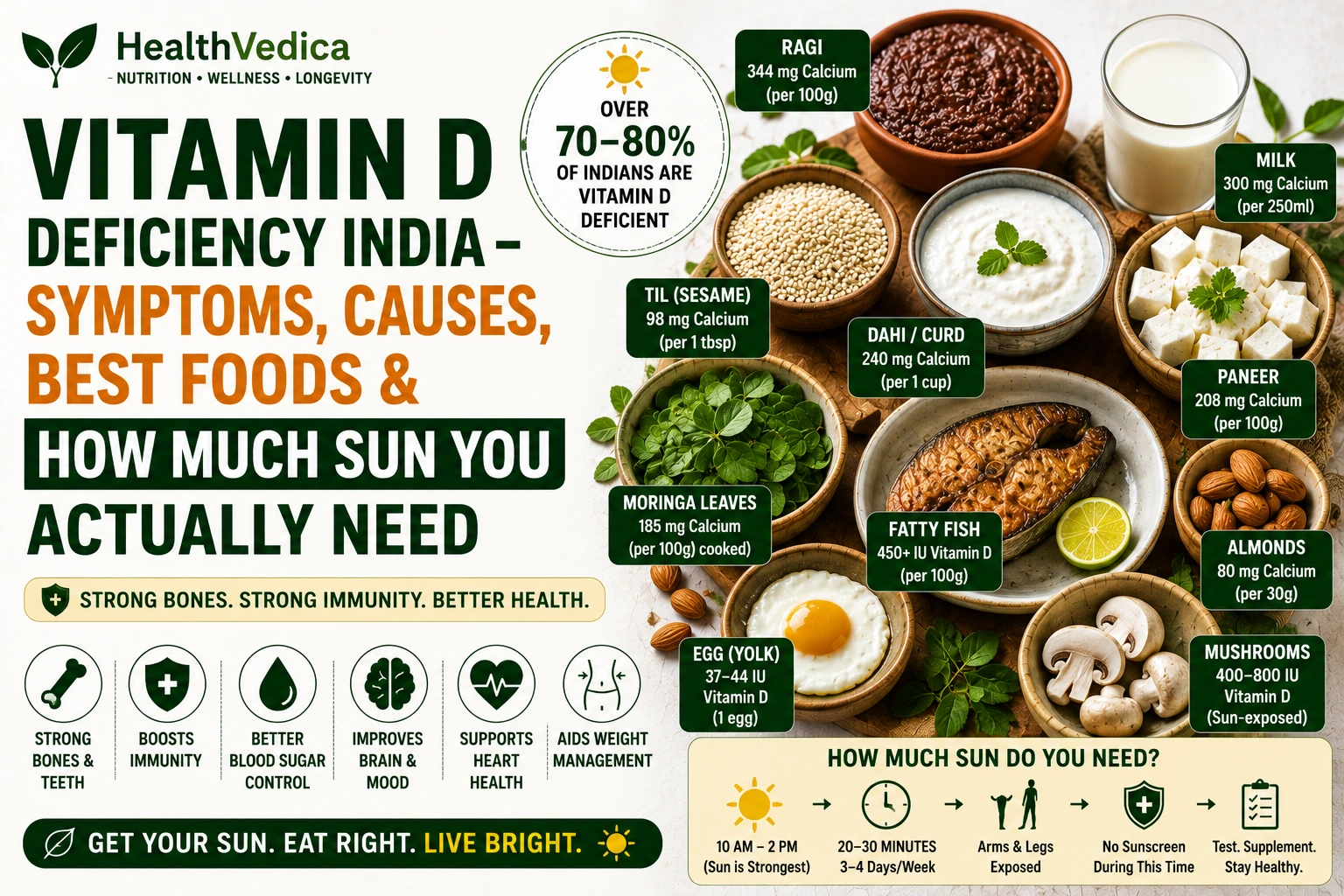
India receives abundant sunshine year-round. Yet paradoxically, over 70–80% of Indians are vitamin D deficient (below 20 ng/mL), making it one of the world's worst vitamin D crisis nations. This paradox is so striking that researchers call it the 'Indian vitamin D deficiency puzzle.'

The consequences are devastating and far-reaching. Vitamin D is not merely a vitamin β€” it's a steroid hormone that regulates over 1,000 genes and virtually every system in the body. Deficiency is linked to: osteoporosis, frequent infections, autoimmune diseases, depression, type 2 diabetes, cardiovascular disease, cognitive decline, increased cancer risk, and poor pregnancy outcomes.

For India specifically, vitamin D deficiency contributes to high rickets rates in children (India has one of the world's highest), escalating tuberculosis burden (vitamin D is critical for immune defence against TB), rapidly rising multiple sclerosis and autoimmune disease prevalence, and the extraordinary rates of metabolic syndrome and type 2 diabetes.

Solving the Indian vitamin D crisis requires understanding why Indians are deficient despite sunshine, then targeting all three solutions: sun exposure, food, and supplementation when needed.

πŸ”¬ Why Are Indians So Vitamin D Deficient Despite All That Sunshine?

Seven key reasons explain the Indian vitamin D paradox:

1. Higher skin melanin: Melanin (responsible for darker skin) acts as natural sunscreen. Indians need 3–6Γ— longer sun exposure than fair-skinned people to synthesise the same amount of vitamin D. A 15-minute exposure that gives a Scandinavian 1000 IU gives an Indian only 150–300 IU.

2. UV-B blocking pollution: Most Indian cities have severe air pollution. Smog and particulate matter absorb UV-B radiation before it reaches skin. Delhi residents receive effective UV-B only 4–5 months per year due to pollution and winter sun angles.

3. Cultural clothing practices: Covering skin for modesty, protection from sun, or occupational reasons dramatically reduces synthesis. Women who cover their face, arms, and legs get virtually zero synthesis.

4. Indoor lifestyles: Urbanisation = air-conditioned offices, cars, and homes. Most urban Indians spend 90%+ of daylight hours indoors.

5. Wrong sun exposure timing: Indians typically go out early morning (below optimal UV-B) and evening. UV-B for vitamin D synthesis is only available when the sun is high β€” 10 AM to 2 PM. Morning walks at 6 AM provide zero vitamin D synthesis.

6. Sunscreen overuse in urban areas: SPF 30 sunscreen blocks 95–98% of vitamin D synthesis. Urban Indians using sunscreen during the day are effectively indoors, vitamin D-wise.

7. Low dietary intake: Unlike Western diets with fortified milk, cereals, and fatty fish, traditional Indian vegetarian diets provide minimal vitamin D.

πŸ“Š Vitamin D Status Reference Chart for Indians

Serum 25(OH)D LevelStatusHealth ImplicationsAction Required
Below 10 ng/mLSevere DeficiencyOsteomalacia, muscle weakness, rickets (children)High-dose prescription treatment
10–20 ng/mLDeficiencyBone loss, immune dysfunction, fatigue, depressionSupplement 4000–5000 IU/day
20–30 ng/mLInsufficiencySuboptimal immune, bone, and metabolic functionSupplement 2000 IU/day + sun exposure
30–60 ng/mLSufficient / OptimalNormal body function, optimal healthMaintain with diet + sun
60–100 ng/mLHigh-normalGenerally safe; may benefit autoimmune conditionsNo change needed
Above 150 ng/mLToxicityHypercalcaemia, kidney damageStop supplementation immediately

βœ… Best Indian Food Sources of Vitamin D

Important note: Very few natural foods contain vitamin D in meaningful quantities. This is why sun exposure and supplementation are often necessary alongside diet for Indians.

1. Fatty Fish (Surmai/King Fish, Bangda/Mackerel, Hilsa)
The richest natural food source. Surmai (100g) provides 450 IU vitamin D; bangda provides 360 IU; hilsa provides 570 IU. For fish-eating Indians, 3 servings per week of fatty fish can contribute meaningfully to vitamin D status. This explains why coastal Indians in Kerala and Goa traditionally had better vitamin D levels than inland/northern populations.

2. Eggs (Yolk)
One egg yolk provides 37–44 IU of vitamin D. While not large, it contributes when combined with sun exposure. Eggs also provide vitamin D3 (the most bioavailable form). Eat the whole egg β€” the yolk is where all vitamin D resides. Pastured/free-range eggs from chickens exposed to sunlight have 3–4Γ— more vitamin D than battery-farmed eggs.

3. Fortified Milk and Dairy
In India, some commercial milk brands (Amul, Mother Dairy) fortify their products with vitamin D. Fortified milk can provide 100–200 IU per 250ml. Check the label β€” not all Indian milk is fortified. Similarly, some yoghurt and paneer brands are now fortified.

4. Mushrooms (Exposed to Sunlight)
Mushrooms naturally contain ergosterol that converts to vitamin D2 when exposed to UV light. Commercially grown mushrooms grown in the dark have minimal vitamin D. However, placing any fresh mushroom (button, oyster) in direct sunlight for 15–30 minutes (gills up) converts ergosterol to vitamin D. This can provide 400–800 IU per 100g. A truly revolutionary tip for vegetarians: sun-dried mushrooms can provide therapeutic vitamin D levels.

5. Cod Liver Oil
One tsp of cod liver oil provides an extraordinary 1360 IU vitamin D β€” the most concentrated natural source. Traditional communities who consumed cod liver oil (and fish liver generally) had excellent vitamin D status. Now available as supplements in India. Also rich in EPA/DHA omega-3 and vitamin A.

🌿 Ayurvedic Perspective on Vitamin D and Bone Health

While the concept of 'vitamin D' didn't exist in classical Ayurveda, the practice of Surya Namaskar (sun salutation) in morning sunlight was a daily prescription for health across all major Indian texts. The importance of sunlight for health was universally recognised in Indian traditions.

Ayurvedic herbs that support vitamin D action and bone metabolism include: Ashwagandha (supports bone mineral density), Shatavari (female bone health), Bala (strengthens muscles and bones), and Guggul (supports bone remodelling). These complement vitamin D therapy without replacing it.

🚫 Mistakes Indians Make With Vitamin D

Morning sun walks for vitamin D: Zero UV-B available before 10 AM in most of India. Morning walks are excellent for mental health and circulation, but don't generate vitamin D synthesis. For vitamin D, you need 10 AM–2 PM sun exposure.

Vitamin D supplements without Vitamin K2: Vitamin D increases calcium absorption. Without vitamin K2, that extra calcium can deposit in arteries rather than bones. Always take vitamin D with vitamin K2 (MK-7 form). Natural sources of K2: fermented foods (dahi, kanji, fermented vegetables).

Vitamin D supplements without Magnesium: Magnesium is required to activate vitamin D. Supplementing vitamin D without adequate magnesium can be ineffective. Eat magnesium-rich foods (bajra, almonds, leafy greens) alongside vitamin D supplementation.

Not testing before supplementing: Get a 25-hydroxyvitamin D blood test before starting supplements. Doses depend on current levels β€” someone at 8 ng/mL needs a different dose than someone at 25 ng/mL.

πŸ’‘ Practical Vitamin D Optimisation Plan for Indians

Step 1 β€” Test: Get serum 25(OH)D tested. Aim: 40–60 ng/mL.

Step 2 β€” Sun exposure (non-negotiable): 20–30 minutes between 10 AM–2 PM, 3–4 days per week. Arms and legs exposed. No sunscreen during this window. Start with 10 minutes and gradually increase.

Step 3 β€” Food upgrades: Fatty fish 3Γ—/week + 2 eggs daily + fortified milk + sun-dried mushrooms (DIY the mushroom sunning method).

Step 4 β€” Supplement (for most Indians): 2000–4000 IU vitamin D3 (cholecalciferol) daily + 100–200 mcg vitamin K2 (MK-7) + magnesium-rich diet. Take with a meal containing fat for best absorption.

Step 5 β€” Retest: After 3 months, retest serum 25(OH)D. Adjust dose to maintain 40–60 ng/mL. Annual testing is ideal.

❓ Frequently Asked Questions

Common questions about How to Increase Vitamin D Naturally

Common symptoms include: persistent fatigue and tiredness (most common), frequent colds and infections, bone and back pain (especially lower back), muscle weakness or aches, mood changes or depression, hair loss (excess shedding), slow wound healing, and brain fog. These symptoms are non-specific, which is why vitamin D deficiency is so often missed β€” always confirm with a blood test (25-hydroxyvitamin D test) rather than diagnosing by symptoms alone.
Depends on current levels from blood test. General guidelines: Severe deficiency (below 10): 60,000 IU per week for 8–12 weeks (prescription), then maintenance. Deficiency (10–20 ng/mL): 4000 IU/day. Insufficiency (20–30 ng/mL): 2000 IU/day. Maintenance for India's population: 1000–2000 IU/day alongside sun exposure. Always test before and after starting supplements. The upper safe limit is generally considered 4000 IU/day for long-term use.
Potentially yes, with the right approach β€” but most urban Indians cannot due to pollution, indoor lifestyles, and clothing. For adequate synthesis: 20–30 minutes of 10 AM–2 PM sun on uncovered arms and legs, 4+ days per week, throughout the year. This is difficult for most working Indians. Supplementation is therefore necessary for the majority of Indians, especially those in metros like Delhi, Mumbai, and Bengaluru.
Yes, strongly. Vitamin D receptors are present in pancreatic beta cells (which produce insulin). Deficiency impairs insulin secretion and sensitivity, significantly increasing type 2 diabetes risk. Studies in India show that people with vitamin D deficiency have 2–3Γ— higher risk of developing diabetes. Correcting vitamin D deficiency improves insulin sensitivity and reduces diabetes progression risk. Given India's epidemic of type 2 diabetes, this is a critical connection.
Vitamin D3 (cholecalciferol) is the form humans synthesise from sunlight and found in animal foods. Vitamin D2 (ergocalciferol) comes from plant/fungal sources and was historically used in many supplements and fortified foods. Research consistently shows D3 is more effective β€” it raises blood levels faster, maintains levels longer, and has greater potency. Always choose vitamin D3 supplements. Vegan D3 (from lichen) is available for those avoiding animal products.
Related Blogs
Ragi vs Jowar Comparison Blogs
Jul 14, 2026
Ragi vs Jowar Comparison
🌾 Two Millets, Two Different StrengthsRagi (finger millet) and jowar (sorghum) are both traditional...
Read More
Best Foods for Fatty Liver Blogs
Jul 14, 2026
Best Foods for Fatty Liver
🫘 Fatty Liver Is Largely Reversible Through DietNon-alcoholic fatty liver disease (NAFLD), now incr...
Read More
Health Benefits of Sprouted Foods Blogs
Jul 14, 2026
Health Benefits of Sprouted Foods
🌱 Sprouting: Awakening Nutritional PotentialSprouting is one of the most remarkable nutritional tra...
Read More
Postpartum Weight Loss Diet India Blogs
Jul 14, 2026
Postpartum Weight Loss Diet India
🀱 Understanding Postpartum Weight LossWeight gain during pregnancy is normal and necessary for a he...
Read More
Best Foods for Digestion Blogs
Jul 14, 2026
Best Foods for Digestion
🌿 Traditional Indian Food Culture Already Understands DigestionLong before gut health became a well...
Read More
Foods for Cold and Cough Season Blogs
Jul 14, 2026
Foods for Cold and Cough Season
🀧 Why Nutrition Matters During Cold and Cough SeasonCold and cough are common seasonal illnesses, e...
Read More
Copper Rich Foods India Blogs
Jul 14, 2026
Copper Rich Foods India
🧬 What Is Copper?Copper is an essential trace mineral required for many important functions in the...
Read More
Foods That Help You Sleep Better Blogs
Jul 14, 2026
Foods That Help You Sleep Better
😴 IntroductionIndia is in the midst of a serious sleep crisis. A 2024 national survey found that 93...
Read More
Keto Diet India Blogs
Jul 14, 2026
Keto Diet India
πŸ₯‘ What Is a Ketogenic Diet?The ketogenic (keto) diet is a very low-carbohydrate, high-fat, and mode...
Read More