🔍 What is Alzheimer's Disease?
Alzheimer's disease is the most common form of dementia — a progressive neurodegenerative disorder that destroys memory, thinking, behavior, and eventually the ability to carry out the simplest tasks. It accounts for 60–80% of all dementia cases. Named after Dr. Alois Alzheimer who first described it in 1906, the disease involves abnormal accumulation of amyloid plaques and tau protein tangles in the brain that damage and kill nerve cells. India has approximately 5.3 million people living with dementia, the majority with Alzheimer's — a number expected to triple by 2050 as the population ages. While the disease is not reversible, early diagnosis and management can significantly slow progression and improve quality of life.
📊 Stages of Alzheimer's Disease
| Stage | Duration | Key Symptoms |
|---|---|---|
| Preclinical (Silent) | Years–Decades | No visible symptoms; brain changes occurring; detectable only by imaging/biomarkers |
| Mild Cognitive Impairment (MCI) | Variable | Noticeable memory lapses (forgetting names, appointments), subtle personality changes, word-finding difficulty |
| Mild Alzheimer's | 2–4 years | Memory loss affecting daily life, getting lost in familiar places, repeating questions, trouble managing money/bills, personality changes |
| Moderate Alzheimer's | 2–10 years | Increasing confusion, inability to recognize family, wandering, incontinence, needing help with basic activities, behavioral problems (agitation, sundowning) |
| Severe Alzheimer's | 1–3 years | Loss of speech, inability to swallow, total dependence on caregivers, susceptibility to pneumonia and infections |
⚠️ Warning Signs — 10 Early Symptoms
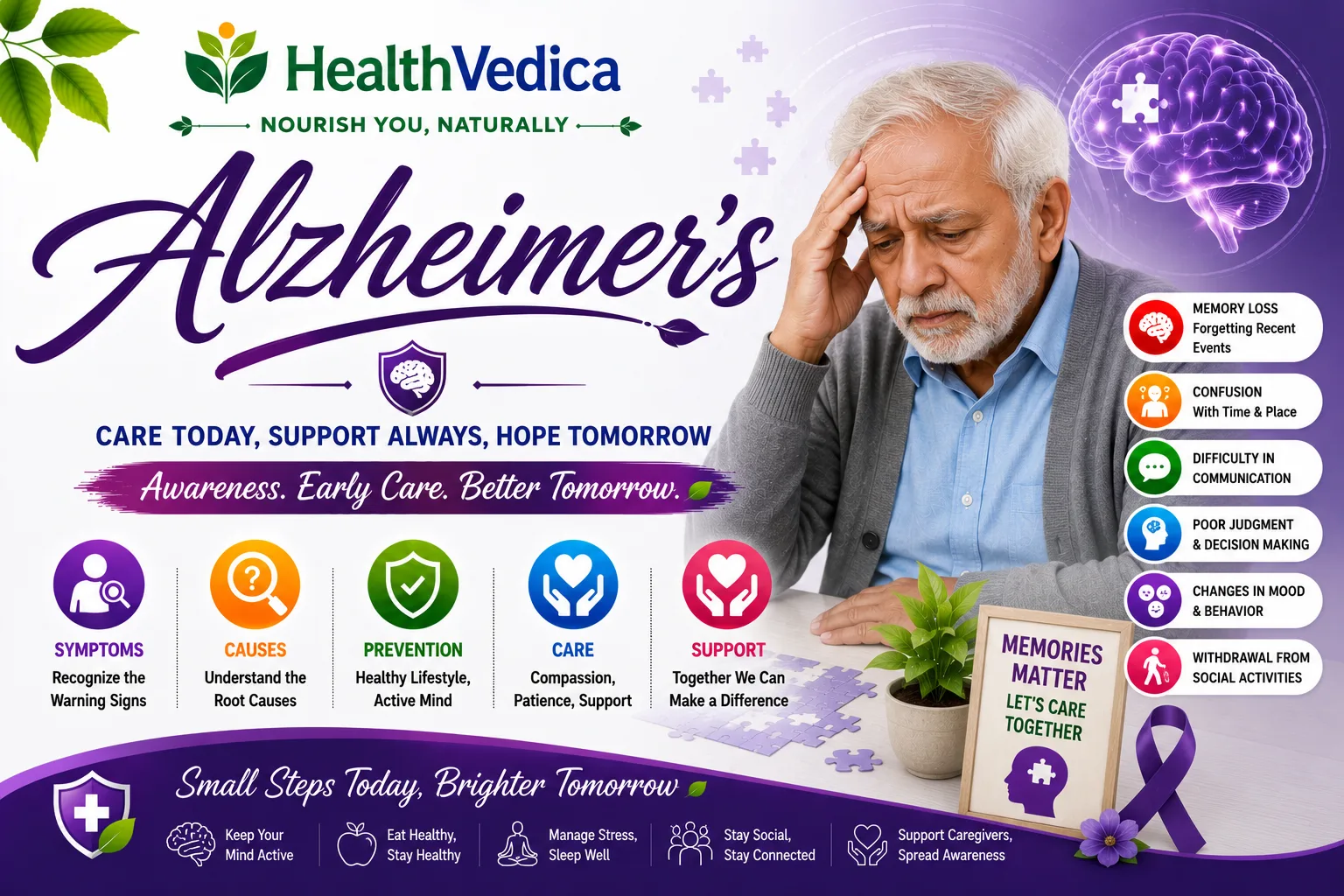
The Alzheimer's Association identifies these early warning signs: Memory loss that disrupts daily life (especially recent events), challenges in planning or solving problems, difficulty completing familiar tasks (cooking, driving), confusion with time or place, trouble understanding visual images and spatial relationships, new problems with words in speaking or writing, misplacing things and losing the ability to retrace steps, decreased or poor judgment, withdrawal from work or social activities, and changes in mood and personality (anxiety, suspicion, depression).
🧬 Causes & Risk Factors
Brain Pathology: Two abnormal protein structures destroy brain cells. Amyloid plaques (clumps of beta-amyloid protein between nerve cells) disrupt cell-to-cell communication. Neurofibrillary tangles (twisted strands of tau protein inside neurons) block nutrient transport within cells, leading to cell death.
Non-Modifiable Risk Factors: Age (primary risk factor — risk doubles every 5 years after 65), Family history and genetics (APOE-e4 gene variant increases risk), Down syndrome (develop Alzheimer's by middle age).
Modifiable Risk Factors (Potentially Preventable): Cardiovascular disease and risk factors (hypertension, diabetes, high cholesterol, obesity), physical inactivity, social isolation, depression, traumatic brain injury, hearing loss, smoking, excessive alcohol, poor sleep, and low educational attainment.
🩺 Diagnosis
Diagnosis involves comprehensive evaluation including medical history, cognitive tests (MMSE, MoCA — Mini-Mental State Examination, Montreal Cognitive Assessment), neurological exam, brain imaging (MRI, CT, PET scans), blood tests (to rule out treatable causes like B12 deficiency or thyroid disorder), and cerebrospinal fluid analysis or PET imaging for amyloid/tau biomarkers in specialized centres. Early and accurate diagnosis enables better planning, access to treatments, and participation in clinical trials.
💊 Medical Treatment Options
| Drug Class | Medications | Stage | Effect |
|---|---|---|---|
| Cholinesterase Inhibitors | Donepezil, Rivastigmine, Galantamine | Mild–Moderate | Improve symptoms temporarily; slow progression modestly |
| NMDA Antagonist | Memantine | Moderate–Severe | Reduces glutamate excitotoxicity; helps with cognitive symptoms |
| Combination | Donepezil + Memantine | Moderate–Severe | Used together for greater benefit |
| Anti-Amyloid (New) | Lecanemab, Donanemab | Early Stage | Removes amyloid plaques; first disease-modifying drugs (2023) |
| Behavioral Medications | Antidepressants, antipsychotics | All stages | Manage agitation, depression, sleep disturbances |
🌿 Ayurvedic Perspective (Smritivibhrama)
In Ayurveda, Alzheimer's-like conditions are described as Smritivibhrama (memory confusion) or Unmada (mental derangement) — attributed to derangement of Vata dosha in the mind and nervous system, along with Prana Vata and Sadhaka Pitta imbalance. Ayurvedic approach focuses on Medhya Rasayana (brain tonics) — herbs that nourish, protect, and rejuvenate brain tissue. Key herbs include Brahmi (Bacopa monnieri — clinically proven to improve memory), Ashwagandha (neuroprotective, reduces amyloid plaques in research), Shankhpushpi (cognitive enhancer), Yashtimadhu/Mulethi (neuroprotective), and Turmeric/Curcumin (reduces amyloid deposits, anti-inflammatory).
🧘 Brain-Protective Lifestyle Strategies
| Strategy | Evidence Level | Recommended Approach |
|---|---|---|
| Physical Exercise | Strong | 150 min/week aerobic exercise; increases BDNF (brain growth factor), reduces amyloid |
| Mental Stimulation | Strong | Reading, puzzles, learning new skills, music, chess; builds cognitive reserve |
| Social Engagement | Strong | Regular social interaction; lonely individuals have 2x higher dementia risk |
| Heart-Healthy Diet | Strong | MIND diet (Mediterranean + DASH): vegetables, berries, fish, olive oil, whole grains, minimal red meat |
| Quality Sleep | Strong | 7–9 hours; brain clears amyloid during deep sleep (glymphatic system) |
| Blood Pressure Control | Strong | Hypertension in midlife doubles dementia risk; treatment shown to reduce risk |
| Stress Management | Moderate | Chronic stress accelerates brain aging; meditation, yoga shown to be neuroprotective |
| Hearing Aid Use | Moderate | Treating hearing loss reduces dementia risk significantly |
🥗 Brain-Boosting Indian Foods
Top Indian foods for brain health: Turmeric (curcumin — gold standard in Alzheimer's prevention research), Brahmi leaves and juice, walnuts (omega-3, polyphenols), blueberries and pomegranate (powerful antioxidants), amla/Indian gooseberry (highest Vitamin C, neuroprotective), dark leafy greens (folate, Vitamin K, lutein), fish especially sardines and mackerel (omega-3 DHA essential for brain), sesame seeds (Vitamin E), and cumin (neuroprotective). Coconut oil (medium-chain triglycerides — alternative brain fuel) is traditionally used in Ayurveda for brain nourishment.
👨👩👧 Caregiving Guide for Indian Families
In India, Alzheimer's caregiving falls predominantly on family members — typically women. Key guidance includes: Create a safe, structured daily routine (reduces confusion and agitation). Secure the home — remove locks from bathrooms, secure exits, cover sharp edges. Maintain consistent communication — speak simply, slowly, and clearly. Use their name, not pronouns. Manage 'sundowning' (late-day agitation) by ensuring good daytime lighting, scheduled physical activity, and calm evening routine. Legal planning early (financial power of attorney) is essential. Seek respite care to prevent caregiver burnout. Contact Alzheimer's and Related Disorders Society of India (ARDSI) at ardsi.org for support groups, training, and resources in India.
📞 Indian Resources
ARDSI (Alzheimer's Related Disorders Society of India): ardsi.org | ARDSI Helpline: Available on website per region | iCall Mental Health: 9152987821 | Vandrevala Foundation: 1860-2662-345 (24/7 helpline)