🍽️ Do You Really Need to Avoid Certain Foods Together?
You've probably heard it at home: don't eat fish with milk, never combine fruit with a meal, or avoid mango with curd. These rules are often presented as facts, but they come from a mix of traditional dietary practices, personal experiences and modern internet claims.
The important question is not whether a combination sounds unusual. It is whether there is a plausible mechanism and good evidence that the combination causes harm.
For most healthy people, the digestive system is built to handle mixed meals containing carbohydrates, protein and fat. The ICMR-NIN Dietary Guidelines for Indians 2024 also focus on overall dietary quality, variety, moderation and nutrient adequacy rather than blanket food-combining rules.
🔬 How Digestion Handles Mixed Meals
Your stomach and small intestine do not digest only one food group at a time. Gastric acid, bile and digestive enzymes work together to break down proteins, carbohydrates and fats from the same meal.
That is why traditional meals such as dal + rice, roti + sabzi + curd, idli + sambar and mixed vegetable meals can fit comfortably into a healthy diet.
Some people do experience bloating, reflux or indigestion after particular meals. That does not automatically mean the foods are chemically incompatible. Portion size, fat content, fibre, lactose intolerance, IBS and individual tolerance can be more relevant.
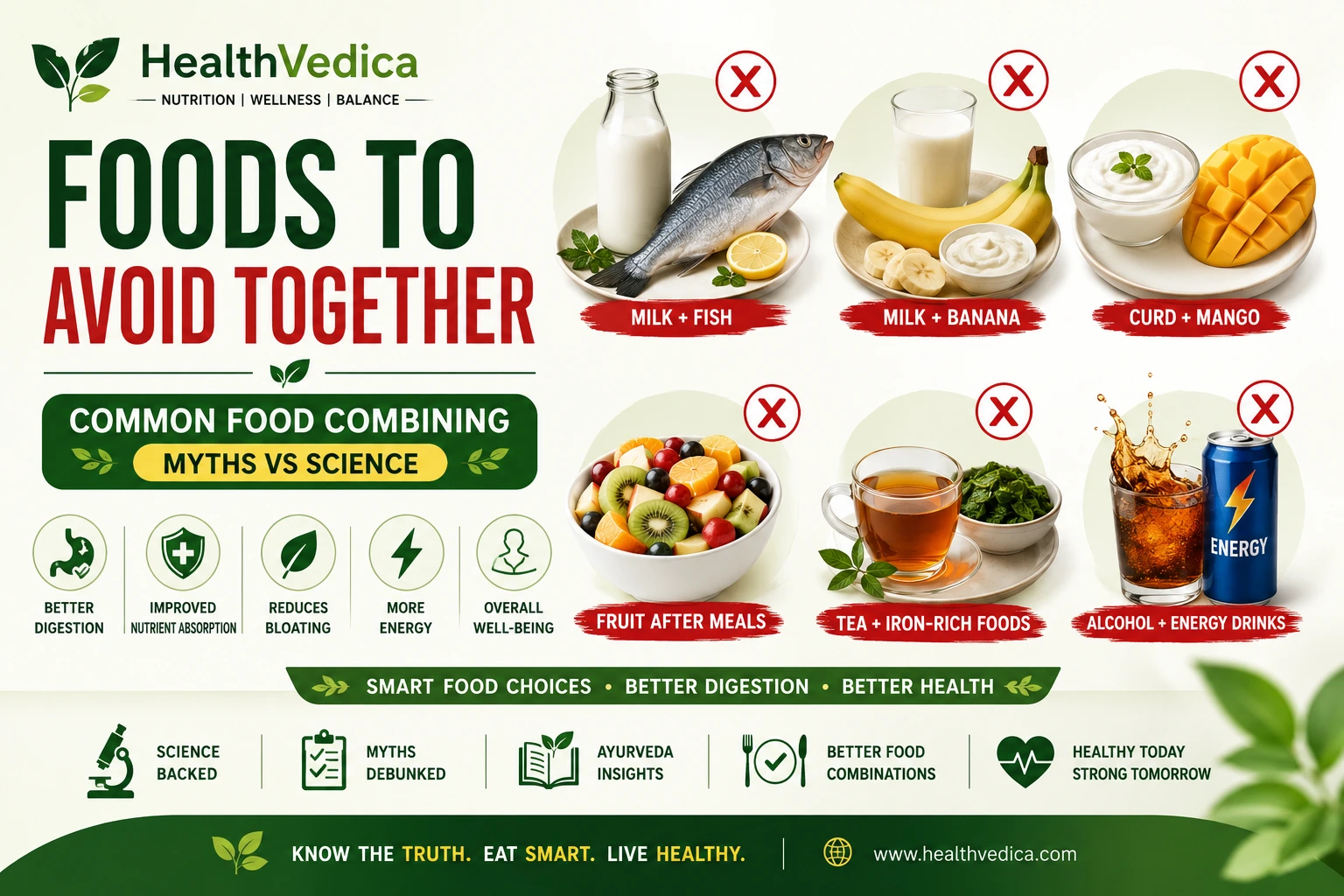
📊 Food Combinations: Myth or Real Concern?
| Combination | Common Claim | What the Evidence Says |
|---|---|---|
| Milk + Fish | Causes vitiligo or skin disease | Not supported by evidence |
| Milk + Banana | Creates toxins | Generally safe for healthy people |
| Mango + Curd | Produces toxins | No established toxic reaction |
| Fruit + Meals | Ferments in the stomach | Usually a myth |
| Tea/Coffee + Iron-rich Meal | Reduces iron absorption | Real interaction |
| Grapefruit + Some Medicines | No interaction | Real risk for some medicines |
| Alcohol + Energy Drinks | Caffeine makes alcohol safer | False and potentially risky |
| Beans + Dairy | Impossible to digest | Usually safe; individual tolerance matters |
❌ Fish and Milk: The Famous Indian Food Myth
There is no established biochemical reaction showing that eating fish and milk together causes vitiligo or other skin diseases.
Fish and dairy are eaten together in many cuisines. If a person develops symptoms after a particular meal, possible explanations include a food allergy, lactose intolerance, spoiled food or simply a large, rich meal—not a special fish-and-milk toxin.
Important: People with a fish allergy should avoid fish regardless of what it is eaten with.
🥛 Banana + Milk: Safe for Most People
Banana and milk provide carbohydrate, protein, calcium and potassium. A banana milkshake can be part of a balanced diet.
If it causes bloating, gas or loose stools, check the portion and consider lactose intolerance or individual sensitivity. You do not need to avoid the combination simply because a food-combining chart says it is “toxic.”
🥭 Mango + Curd: No Evidence of “Toxins”
Mango with curd or yoghurt does not have a known toxic chemical reaction. The combination can provide carbohydrate, protein, calcium and other nutrients.
People with lactose intolerance may experience symptoms from the dairy component, while people with reflux or sensitive digestion may prefer smaller portions. That is an individual tolerance issue, not proof that the combination is poisonous.
🍎 Fruit After Meals: Does It Ferment?
One of the most persistent claims is that fruit “gets stuck” and ferments when eaten after a meal. In a healthy digestive system, this is not how digestion works.
Whole fruit can be eaten with or after meals. In fact, ICMR-NIN recommends whole fruits over fruit juices because whole fruit provides fibre and tends to be more filling.
If fruit after a large meal makes you uncomfortable, try a smaller portion or eat it at another time. Your comfort matters, but the rule is not universal.
⚠️ The Combination That Really Matters: Tea, Coffee and Iron
This is where food-combination advice becomes useful. Tea and coffee contain compounds that can interfere with the absorption of non-heme iron, the form found mainly in plant foods.
The ICMR-NIN Dietary Guidelines advise avoiding tea and coffee around meals; Indian government nutrition guidance similarly recommends spacing them away from meals when improving iron intake is important.
Pair plant sources such as dal, beans and leafy vegetables with vitamin-C-rich foods such as guava, amla, lemon or other citrus to support iron absorption.
💊 Grapefruit + Medicines: A Genuine Interaction
Grapefruit can affect enzymes and transport proteins involved in the handling of certain medicines. This can increase or decrease drug exposure depending on the medicine.
The important point is that the interaction is medicine-specific. Do not assume every medicine interacts with grapefruit, but do not ignore the warning if your pharmacist or doctor gives it.
If you take prescription medicines regularly, check the patient information or ask your pharmacist before making grapefruit a daily habit.
⚠️ Alcohol + Energy Drinks
Caffeine does not cancel alcohol's effects. A caffeinated drink may make someone feel more alert while they remain impaired by alcohol. This can encourage riskier behaviour or greater alcohol consumption.
For health and safety, combining alcohol with highly caffeinated energy drinks is best avoided.
🌿 What About Ayurveda and Viruddha Ahara?
Ayurveda has a detailed dietary framework that considers Samyoga (combination), quantity, preparation, timing, place and the individual consuming the food. The Ministry of Ayush's Ayurveda guidance also recognises food combination and preparation as part of traditional dietary assessment.
Traditional Ayurvedic incompatibility concepts should be presented as Ayurvedic principles, not automatically as modern toxicology findings. Where modern evidence is available, it is useful to distinguish the two rather than mixing them together.
✅ Food Pairings That Can Improve Nutrition
| Pairing | Why It Helps |
|---|---|
| Vitamin C + Plant Iron | Supports absorption of non-heme iron |
| Legumes + Cereals | Provides complementary protein amino acids |
| Vegetables + Healthy Fats | Fat helps absorption of fat-soluble vitamins |
| Whole Fruit + Meals | Adds fibre, vitamins and minerals |
🚫 When Should You Actually Avoid a Food Combination?
- You have a diagnosed food allergy or intolerance.
- A medicine you take has a documented food interaction.
- You are managing iron deficiency and regularly drink tea or coffee with meals.
- A combination consistently triggers reflux, bloating or diarrhoea for you.
- The meal is extremely large, high-fat or high-sugar and repeatedly causes discomfort.
💡 The Bottom Line
You do not need a long “forbidden combinations” list to eat well. Most healthy people can eat mixed meals without worrying that ordinary combinations will create toxins.
Pay more attention to the things that have stronger evidence: overall diet quality, adequate protein and fibre, whole fruits and vegetables, sensible portions, iron absorption, medication interactions and your own food tolerance.
Food traditions can be valuable, but they are not a substitute for evidence. The smartest approach is to respect traditional practices while clearly separating them from claims that have not been demonstrated scientifically.