🩸 Introduction
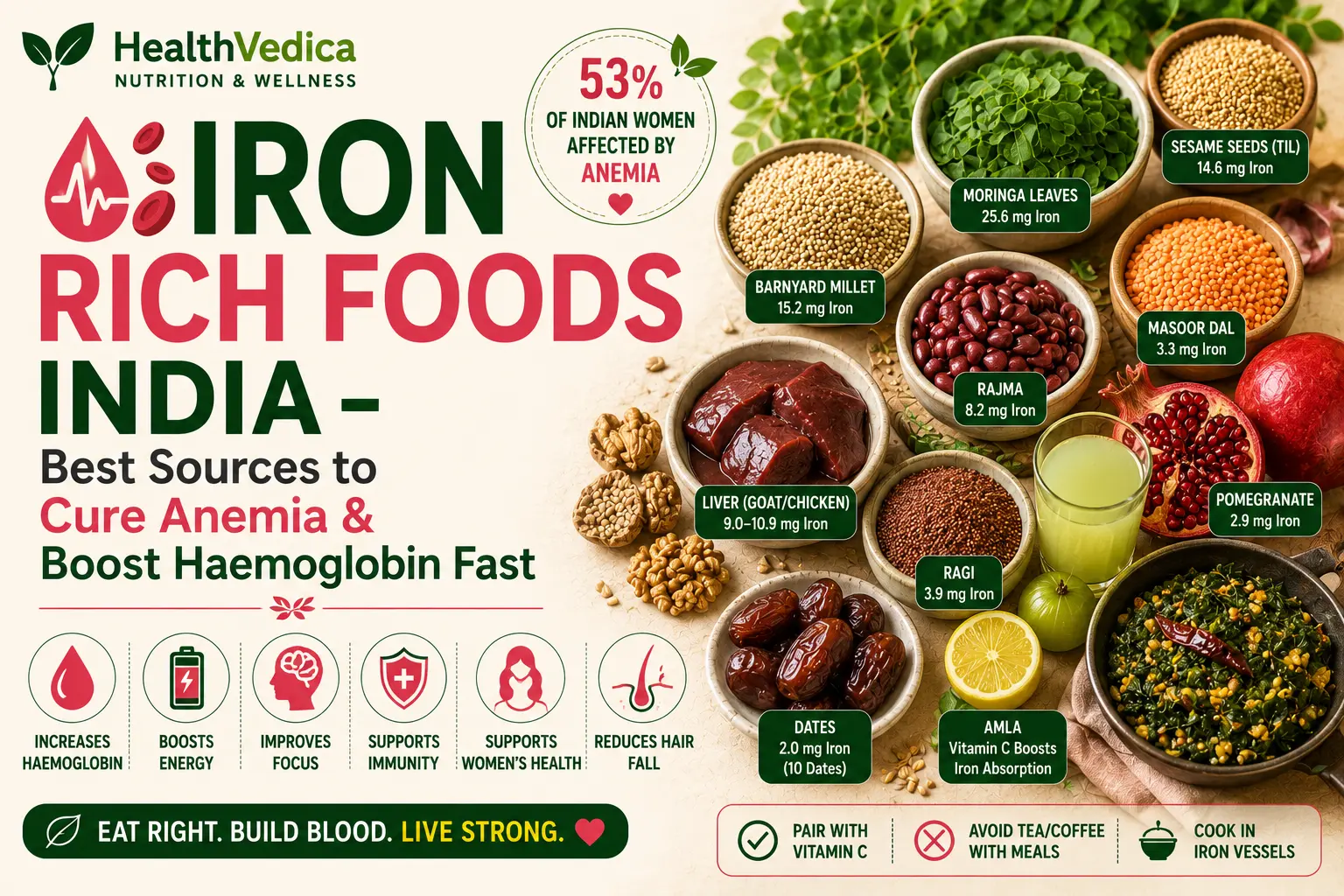
India has the highest burden of anemia in the entire world — with 53% of Indian women, 50% of children under 5, and 23% of Indian men suffering from iron deficiency anemia. Yet this is almost entirely preventable through correct diet. Anemia from iron deficiency means your blood cannot carry enough oxygen to your cells — causing crushing fatigue, breathlessness even on mild exertion, pale skin, cold hands and feet, poor concentration, significant hair loss, brittle nails, and in pregnant women, significantly increased risks of preterm birth and dangerously low birth weight. The tragedy is that India has an abundance of iron-rich traditional foods — but widespread dietary misconceptions, poor absorption habits, and poor food combining are preventing Indians from getting the iron their bodies desperately need. This comprehensive guide covers every iron-rich food available in India, the critical difference between heme and non-heme iron, and the exact food combinations that can double and triple your iron absorption.
🔬 Heme Iron vs Non-Heme Iron – Why This Difference Matters
Not all dietary iron is equal. Heme iron — found in meat, poultry, and fish — is directly absorbed by the body at a rate of 25–35%. Non-heme iron — found in plant foods like dal, spinach, and ragi — is absorbed at only 2–20% depending on what you eat alongside it. This is precisely why vegetarians who make up 30–40% of India's population are at much higher risk of iron deficiency. However, this absorption gap can be dramatically narrowed by eating iron-rich plant foods with Vitamin C (which converts non-heme iron to the more absorbable ferrous form, increasing absorption 4–6 fold), cooking in cast iron vessels (which leaches dietary iron into food — especially acidic foods), and soaking and fermenting grains and legumes which reduces phytic acid that blocks iron absorption.
📊 Complete Iron Content Table of Indian Foods per 100g
| Food | Iron per 100g | Iron Type | Absorption Rate |
|---|---|---|---|
| Moringa Leaves (Drumstick / Murungakkai) | 25.6 mg | Non-heme | High — very low anti-nutrients |
| Sesame Seeds (Til / Gingelly) | 14.6 mg | Non-heme | Moderate |
| Barnyard Millet (Sanwa / Kuthiraivali) | 15.2 mg | Non-heme | Moderate |
| Lotus Seeds (Makhana) | 13.9 mg | Non-heme | Moderate |
| Liver — Goat or Chicken | 9.0–10.9 mg | Heme | Very High — 25–35% |
| Rajma (Kidney Beans) | 8.2 mg | Non-heme | Low–Moderate — soak before cooking |
| Chana — Chickpeas | 4.3 mg | Non-heme | Moderate |
| Ragi (Finger Millet) | 3.9 mg | Non-heme | Moderate — ferment for best absorption |
| Spinach (Palak) | 3.5 mg | Non-heme | Low — oxalates reduce absorption significantly |
| Masoor Dal (Red Lentils) | 3.3 mg | Non-heme | Moderate |
| Dates (Khajoor — 10 dates) | 2.0 mg per 10 dates | Non-heme | Moderate |
✅ Top 5 Iron-Rich Foods Every Indian Should Know
1. Moringa Leaves (Drumstick / Murungakkai): With 25.6mg of iron per 100g — more than 7 times the iron of spinach — moringa leaves are India's most iron-dense plant food. Unlike spinach which is high in oxalates that bind and reduce iron absorption, moringa has very low anti-nutrient content, meaning far more of its iron is actually bioavailable. Just one cup of moringa leaves added to your dal or sambar every day can meaningfully address iron deficiency over time. 2. Sesame Seeds (Til): With 14.6mg of iron per 100g, sesame seeds are one of the most iron-dense plant foods in the world. They are also rich in Vitamin C which helps boost their own non-heme iron absorption. Use as til chutney, til ladoo, or sprinkle on vegetables and dal. 3. Barnyard Millet (Sanwa): With 15.2mg of iron per 100g — the highest iron content of any millet and one of the highest of any common Indian grain — replacing white rice with barnyard millet for 3 months has been shown to significantly raise hemoglobin levels in anemic women in research studies. 4. Rajma (Kidney Beans): With 8.2mg of iron per 100g, rajma is North India's most beloved legume and one of its most iron-rich. Always eat rajma with tomatoes and a squeeze of lemon (Vitamin C) for maximum iron absorption. The classic rajma chawal with lemon is actually perfect iron nutrition science. 5. Chana and Masoor Dal: These everyday Indian legumes provide 3–4mg of iron per 100g with moderate bioavailability — making them solid daily contributors to iron intake when consistently eaten with Vitamin C sources like tomato, lemon, or amla.
🍋 Foods That Boost Iron Absorption – Always Eat These With Iron Foods
Vitamin C is the most powerful iron absorption enhancer known to nutritional science — it converts non-heme iron from plant sources into the more absorbable ferrous form, increasing absorption by up to 4–6 times. The best Indian Vitamin C sources to pair with iron-rich foods are lemon juice (squeeze on dal, palak, and rajma), fresh amla (one amla provides more Vitamin C than an orange), tomatoes in every dal tadka, capsicum or bell pepper, and fresh coriander leaves. Practical combinations that work particularly well: spinach dal with a lemon squeeze gives maximum iron from spinach; rajma chawal with tomato-based gravy and lemon is an iron-optimized classic Indian meal; ragi porridge with amla juice is a powerful breakfast iron combination; barnyard millet upma with tomato chutney provides high-iron, low-GI breakfast nutrition.
🚫 Foods That Block Iron Absorption – Avoid These with Iron Meals
Tea and coffee with meals — tannins in chai and coffee bind to non-heme iron and reduce absorption by up to 60–80%. Never drink chai within 1 hour of an iron-rich meal. This single habit change alone can dramatically improve iron status in many Indians. Excess calcium — high dairy intake at the same meal competes with iron for absorption through the same transporters. Avoid drinking a large glass of milk with iron-rich meals. Phytic acid in raw grains and legumes — always soak and preferably sprout legumes and grains before cooking to significantly reduce phytic acid content. Antacids and proton pump inhibitors — stomach acid is essential for converting iron to its absorbable form; people on long-term antacids commonly develop iron deficiency as a side effect. Oxalates in raw spinach — raw spinach is actually a poor iron source due to oxalates; cooking reduces oxalate content significantly, and always pair cooked spinach with lemon for best iron yield.
🌿 Ayurvedic Herbs for Anemia (Pandu Roga)
Ayurveda classifies iron deficiency anemia as Pandu Roga — a condition of pallor caused by depletion of Rasa and Rakta Dhatu (plasma and blood tissues). Classical Ayurvedic treatment combines iron-rich foods with herbal formulas that improve iron metabolism and blood tissue formation. Punarnava Mandura is the classical Ayurvedic iron supplement made from purified iron oxide with Punarnava herb — clinically validated for anemia treatment. Loha Asava is an iron-based fermented Ayurvedic preparation. Shatavari nourishes Rakta Dhatu and is particularly important for menstruation-related iron loss in women. Moringa (Shigru) was prescribed in Ayurvedic texts as a primary food for building blood and restoring vitality after illness.
✅ 1-Week Anti-Anemia Indian Meal Plan
Daily non-negotiables: 20ml amla juice on empty stomach each morning for Vitamin C to boost iron absorption all day; moringa powder added to lunch dal or sambar; lemon squeeze on all iron-rich foods; avoid chai for at least 1 hour after every meal. Monday: Breakfast — ragi porridge with dates and amla juice. Lunch — rajma chawal with tomato gravy and lemon. Dinner — moong palak dal with bajra roti. Tuesday: Breakfast — barnyard millet upma with moringa powder and tomato chutney. Lunch — chana masala with rice and lemon. Dinner — masoor dal with spinach and roti. Continue this pattern throughout the week, rotating iron-rich foods with Vitamin C pairings at every meal to maximize iron absorption from plant sources.