Quick answer
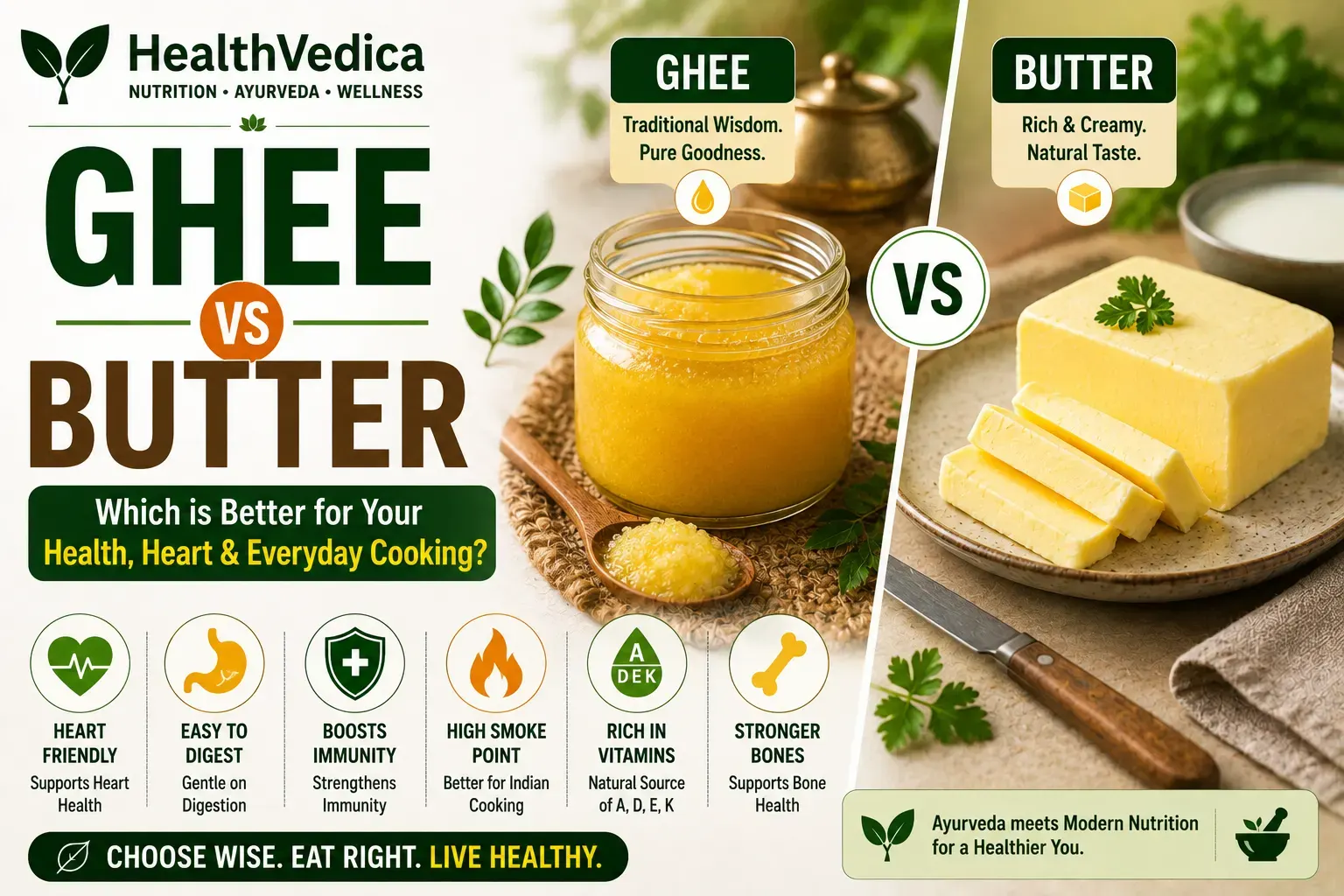
There is no single food that is automatically healthier for everyone. Ghee vs Butter Comparison are useful choices in different situations, and the better option depends on your overall diet, portion size, cooking method and personal needs. This guide compares the two foods in plain language so you can make an informed choice.
📊 Ghee vs Butter: Nutritional Comparison (per 100g)
| Nutrient | Ghee | Butter | Advantage |
|---|---|---|---|
| Total fat | 99.5g | 81g | Butter (lower fat overall) |
| Saturated fat | 62g | 51g | Butter (marginally lower) |
| Smoke point | 250°C | 150–175°C | Ghee (significant) |
| Lactose & casein | Negligible (removed) | Present | Ghee |
| Vitamin A | 3069 IU | 2499 IU | Ghee |
| Shelf life (room temp) | Months, unrefrigerated | Days, needs refrigeration | Ghee |
| Calories | 900 kcal | 717 kcal | Butter (lower) |
✅ Where Ghee Wins
Lactose and casein intolerance: Since the milk solids are strained out during clarification, ghee contains virtually no lactose or casein, making it suitable for most people with dairy sensitivities who cannot tolerate regular butter.
High-heat cooking: Ghee's smoke point of 250°C is far above butter's 150–175°C, meaning it can handle tadka, deep frying, and high-heat sautéing without breaking down into harmful compounds — something butter cannot do.
Shelf stability: Because the water and milk solids that cause spoilage are removed, ghee stays fresh at room temperature for months, while butter requires refrigeration and spoils faster.
✅ Where Butter Wins
Slightly lower fat and calorie density: Butter retains some water content, making it marginally lower in fat and calories per gram than ghee, which is pure fat.
Flavour and texture in baking: Butter's water content and milk solids contribute to flakiness and browning reactions in baked goods that ghee, being pure fat, cannot replicate as effectively.
Cost and availability globally: Outside South Asia, butter is typically cheaper and more universally available than ghee, making it the practical default for many kitchens.
🍽️ Which Should You Choose?
For high-heat Indian cooking, dairy sensitivity, or long shelf life without refrigeration, ghee is the clear winner. For baking, spreading on toast, or where a slightly lower fat content matters, butter remains a solid choice. Many Indian households use both — ghee for tadka and cooking, butter occasionally for toast or Western-style baking.
Sources and context
Nutrition guidance in this article is framed around Indian dietary guidance from ICMR–National Institute of Nutrition (ICMR-NIN). Where Ayurveda is discussed, it is presented as a traditional framework and kept separate from modern clinical evidence. The Ministry of AYUSH's published guidance emphasises factors such as food quality, preparation, quantity, timing and individual suitability; these principles are useful context, but they should not be treated as a substitute for diagnosis or medical treatment.
Important: Nutrition needs vary with age, pregnancy, medications and medical conditions. If you have diabetes, kidney disease, coeliac disease, a food allergy or another diagnosed condition, use personalised advice from a qualified clinician or dietitian.